Louis Malle : sorry, no controversy.
Louis Malle had the knack for getting scandal lovers excited, then cruelly disappointed : they came into the theatre salivating and hungry for controversy, came out with empty hands and stomach, hungry, angry and fuming.
Whether they touched upon an incestuous mother-son relationship (« Le souffle au coeur »- 1971) or depicted a young girl’s life in a New Orleans brothel (« Pretty baby » - 1978) , Louis Malle’s films did so with utmost tact.
In 1974, controversy spin masters thought they had the director at their mercy : he had cornered himself in making a film about WW2 France.
Was he going to portray a country of collaborationists, underground fighters or cynical opportunists ? Whatever his choice, he was dead meat.
They bought seats for historical pornography and exited as frustrated as four years later from « Pretty baby »’s whorehouse. Like a magician locking himself into his box, Louis Malle had once more escaped, while the advertising bastards were selling tickets on their backs.
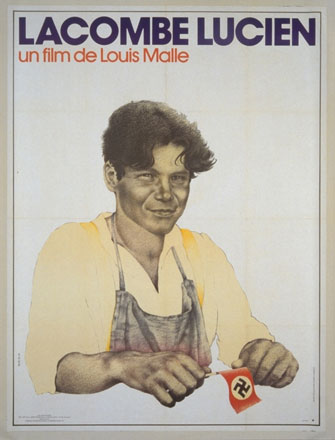
The film title was nevertheless without ambiguity : « Lacombe Lucien » tells an individual story, not a collective one.
Lacombe, Lucien : last name, first name ; the way French « Etat civil » and all official documents record a citizen’s identity, the way Lucien Lacombe’s name appeared in French police registers, would later feed statistics about WW2 France.
Lucien Lacombe is a country boy from South Western France ; he works as an orderly in the local hospital, lives on a farm with his mother and her lover -his father is a war prisoner- ; they want him out.
In 1944, Lucien becomes a French assistant to the German Police. He does so nearly by accident. He wants to join « Résistance », but is rejected by the school teacher. A flat tire on his bike partly decides his fate for him.
Lucien discovers power and easy living and likes it. He can be ruthless and cruel, treat men as the rabbits he used to skin. He informs against the underground school teacher.
Lucien splits his days between the local mansion where the collaborationists gather and an apartment where a Jewish tailor has fled Paris and is hiding with his family. Lucien courts his daughter, France, but denounces the tailor to the Gestapo.
When a German soldier comes to arrest France and her mother, he shoots him and escapes with the women.
Lucien’s behaviour is erratic, this is why he makes sense. Though the film is said to be based on a true story, maybe no Lucien Lacombe existed, maybe no collaborationist followed a similar path ; the film nevertheless convinces it could -must- have happened.
Lucien is pure instinct, not dumb but rough. Ill-equipped for self-analysis, he is no intellectual, nor historian : it is not up to him to trace the sociological roots of French « Collaboration » to age-old Jew hatred or 3rd Republic scandals, he has no global perspective on WW2. As a thinker, Lucien is worse than Rodin’s muscular sitter.
Lucien is not a Nazi, he probably has no clue what this really means, but he may be worse : an acting or « de facto Nazi ». Without such ideology indifferent helpers, hard-core Nazis would have gone nowhere ; to hate Jews should be a prerequisite to betray them.
Lucien is also no skilful opportunist : he signs as a French assistant to German Police in June 1944 ; in the same instant as he gains power and a status, he becomes a sucker. Like in a suspense film, we know something he ignores : he has lost.
Lucien is guilty -vis-à-vis his victims, if not the onlookers who take no sides-, at times hateful ; overall though, he remains likeable. « Lacombe Lucien » succeeds as a film, because Lucien is a creative creation and not a sociological reconstruction.
posted by the serial sports amateur at 4:10 PM


0 Comments:
Post a Comment
<< Home